


Operations | Organisation | Process | Strategy | Technology
STAY CONNECTED AND SIGNUP TO RECEIVE INSIGHT updates
In one of Eli Goldratt’s last essays, his introduction to the TOC Handbook, he wrote: ‘Can we condense all of TOC into one sentence? I think it is possible to condense it into a single word: focus.’
[ Listen to audio version, read by David Hodes]
This is Part 1 of our series on The 5-Step FOCUS: Part 1 | Part 2 | Part 3 | Part 4 | Part 5 | Part 6 | Part 7
He went on to add ‘there are many different definitions to the word focus, but a good starting point is a simple definition such as “Focus: doing what should be done”.’ The 5-Step FOCUS is arguably Goldratt’s most significant contribution to teaching the world to think about systems and system performance. I want to take the opportunity to explore more deeply what it means to me and how it has always been the heuristic with which I start every assignment and to which I return when I get stuck.
So, to begin with, let’s lay out those five steps:
It’s worth noting that Goldratt’s official version has the following formula:
1. Identify the constraint
2. Exploit the constraint
3. Subordinate to the constraint
4. Elevate the constraint
5. Avoid inertia, start again
Although the process doesn’t change, despite our change in the wording, I find the language of exploit and subordinate very harsh. It may suit the temperament of an iconoclastic Israeli physicist, philosopher and teacher. Still, for the uninitiated, it puts an unnecessary emotional negative charge in place before they even get started. And, I must confess that I rather like the fact that our formulation creates an acrostic, which spells out the word FOCUS.
But, the truth is that whether we are talking about Goldratt’s definition of focus (doing what should be done), or the 5-Step FOCUS process itself, there are two questions we have to answer before we can even get started. Some have suggested that because of this, it should be called the 7-step INFOCUS where the ‘I’ stands for identify the system under examination and the ‘N’ for nominate the goal.
This article will thus be the first in a series of seven, in which we will explore all seven steps to see if we can draw a fuller meaning from Goldratt’s insight. We will think through how we can use it to consistently deliver the great gifts that productivity improvements bestow.
What’s a system?
Let us, therefore, begin with the idea of identifying the system. The definition I like to use is that a system, made up of parts, can do something that the parts alone cannot. A valve, a pump and a motor are each components of a system capable of controlling fluid flowing through a pipe. However, none of each of those components, on their own, is capable of managing the desired flow of fluid.
If we stand back a bit further, we can see that these three components, even when assembled together, cannot do anything useful unless we control them. That control might come from an operator who manually turns the valve and flicks the switch for the motor. Or it might be programmed in from the control room once the system has met certain conditions of temperature and pressure.
Standing even further back, we can recognise the fact that someone had to have programmed the controls so that they actuated the equipment. And the power that drives the actuators is connected to the grid—an entire electricity distribution system, itself tied to a system of boiler, turbine and generator, coupled to the supply chain for natural gas and on it goes to the beginnings of the design of the project to drill and use the gas.
And, in each of these network nodes are groups of people who have been educated in a schooling system, trained in a variety of learning systems, organised into management hierarchy systems, and governed by work planning and execution systems. But, that’s not all, as the plant and equipment, and all the people who make it work, live and breathe in our earthly ecosystem, which is itself a member of the solar system. And on it goes.
Gaining some perspective
Rusty Schweickart, an astronaut on the Apollo 9 mission, had this to say about the view from above: ‘The size of it, the significance of it—it becomes both things, it becomes so small and so fragile, and such a precious little spot in the universe, that you can block it out with your thumb, and you realise that on that small spot, that little blue and white thing is everything that means anything to you. All of history and music, and poetry and art and war and death and birth and love, tears, joy, games, all of it is on that little spot out there that you can cover with your thumb.’
I believe that when Dr Deming spoke of appreciation for a system as being a prerequisite of his system of profound knowledge, he was considering all of these levels. Thus, when we contemplate the first of the seven steps as identifying the system, we should be cautious before leaping in and choosing only the pump, valve and motor. It’s a principle of systems thinking that primacy resides in the whole and not in the collection of parts. It takes the orchestra to sound the symphony, no matter the virtuosity of each player.
Where to draw your system boundary
From a practical perspective, what should you consider when drawing your rope around the boundary of your system? There is the familiar concept of your sphere of influence and your span of control, with the former sometimes reaching out well beyond the latter. If you have accountability for an improvement of a system that sits entirely within your span of control, happy days. But that is rarely the case.
The nature of systems is such that you interact with other parts to accomplish a result. Who, then, can you influence to make the changes for which you’re accountable? You should seek to get formal authorities for the work you’ll be leading across the silos and use a practical task assigning method such as that defined by Elliot Jaques in The Requisite Organization.
It would be best if you paused to consider the nature of the system under examination using, for example, Dave Snowden’s Cynefin framework. It has summarised descriptors and recommendations for four different domains of complexity, each of which offers decision-makers a sense of place, or habitat, from which to view their perceptions. Depending on the system and the type of complexity, different approaches will deliver different outcomes.
• Obvious: Tightly constrained, no degrees of freedom. Sense-categorise-respond. Best practice.
• Complicated: Governing constraints, tightly coupled. Sense-analyse-respond. Good practice.
• Complex: Enabling constraints loosely coupled. Probe-sense-response. Emergent practice.
• Chaotic: Lacking constraint, decoupled. Act-sense-response. Novel practice.
Ken Wilber offers a very popular Integral Theory framework with its ‘all levels, all quadrants’ systems map, used to examine people in their context:
• Interior Individual – intention
• Exterior individual – behaviour
• Interior collective – cultural
• Exterior collective – social
In our Ensemble, we have developed our spaceship model which examines the process of innovation through the lenses of strategy, culture, language, organisation, resources, operations, people, process and technology.
Whatever the framework you use to identify your system, there is a paradoxical truth. As Peter Senge put it: ‘…we have a new systems axiom ¬¬¬– what is most systemic is most local. The deepest systems we enact are woven into the fabric of everyday life, down to the most minute detail.’
“Each of us has agency in the systems within which we act”
The implication should be obvious. Each of us in our way has agency in the systems within which we act. When we pay attention to our intention, we notice that we entangle ourselves in a continuous process of being and becoming. Reality is not something that exists out there, in an inanimate system that runs like a machine, the levers and buttons of which we can pull and push until the world deems to make us happy. Reality flows through us, and is shaped as much by our personal cognitive and emotional capacities as it is by what our scientific reasoning provides us with empirical truths.
At Ensemble, we find the idea of mythology a useful way to think about systems. The word mythology comprises of its two parts: ‘mythos’ and ‘logos’. Put plainly, the mythos is the story we tell ourselves about where we came from, who we are and why we do what we do. The logos is the objective logic and reasoning behind the how, when and what we enact in our systems, to reach our goals. Put even more simply, the mythos is the narrative, and the logos is the process.
When we take that first step to identify our system, to call out where the boundary is, it’s valuable to spend some time contemplating both the story we tell ourselves, as well as the ‘measured by numbers’ facts of the boxes and arrows. Paying attention to both sets the scene for us to start the process of establishing the system goal.
____________________________
This is Part 1 of our series on The 5 Step FOCUS.
Part 1: Identifying the System
Part 2: Setting the Goal
Part 3: Part 3
Part 4: Optimise the Constraint
Part 5 : Collaborate Around the Constraint
Part 6 : Uplift System Performance
Part 7 : Start Again
____________________________
What’s next?
The change from standard thinking to Theory of Constraints (TOC) is both profound and exhilarating. To make it both fun and memorable, we use a business simulation we call The Right Stuff Workshop.
We’d love to run it with you. To learn more:
- download the brochure (no email required)
- schedule a call
____________________________
____________________________
An AI Enabled Mining and Metals Operating Model
The Shortest Path From Mineral Potential to the Highest Sustainable Cash Flow
A mining investment earns its return through the conversion of mineral potential into dependable cash flow. Every uncertainty, delay and misplaced commitment along that journey affects how much capital is required, how long it remains exposed and what the investment ultimately delivers.
For those who allocate capital, the challenge extends beyond identifying an attractive resource. The acquisition thesis depends on connected decisions across geology, studies, approvals, construction, commissioning, production and closure. Each decision can strengthen the investment case or quietly erode it.
An AI enabled Mining and Metals Operating System connects evidence, reasoning, accountability and execution across that journey. Systems Thinking provides the whole asset perspective. The Theory of Constraints directs attention towards the factor governing value today. AI helps people interpret information, examine alternatives and coordinate the work required to change the outcome.
“Where is the greatest gap between the value this asset could credibly create and the value it is currently on course to deliver?”
The operating model below brings these ideas together: human accountability above, the life of mine across the centre, and integrated knowledge and reasoning supporting every stage.
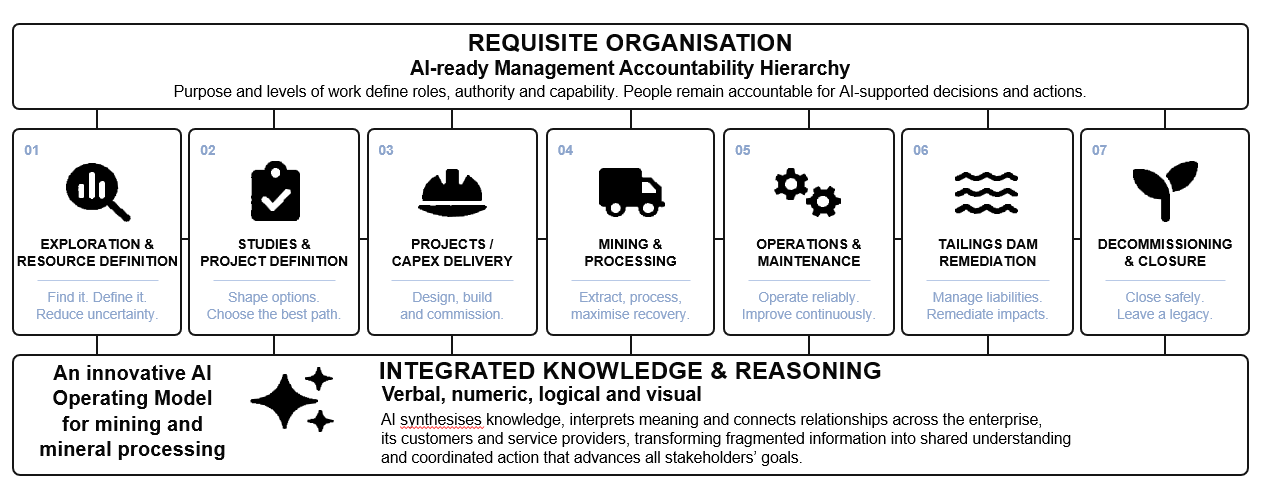
Requisite Organisation: put accountability where the work sits
An operating system needs a clear management accountability hierarchy. Purpose and levels of work define the decisions people must make, the authority they require and the capability needed to carry their responsibilities.
A supervisor protecting today’s production, a project director preparing commissioning and a board allocating development capital face different levels of complexity and different time horizons. Each needs information appropriate to the work, clear decision rights and a reliable route for escalation.
AI makes this clarity more important. Recommendations must have accountable human owners, particularly where commitments cross the boundaries between investors, asset owners, contractors and service providers.
For investors, this provides a practical test of execution capability: can the organisation show who owns each assumption in the investment thesis, who can authorise action and how unresolved issues reach the right decision maker?
Exploration and Resource Definition: reduce the uncertainty that matters
Exploration creates value when it resolves uncertainty that changes a worthwhile decision. More data becomes useful when it improves confidence about what is present, where it lies and what further work is justified.
AI can help connect geological reports, assay results, drilling records, geophysical observations and three dimensional interpretations. Shared terminology and traceable relationships allow teams to compare evidence, expose inconsistencies and distinguish observations from interpretations.
The investor’s question is which uncertainty governs the next commitment. A targeted investigation may change the development route, support further drilling or reveal that the opportunity cannot yet justify additional capital.
New sensing and interpretation methods must earn confidence through appropriate validation. The objective is a better sequence of learning and commitment, with uncertainty visible throughout.
Studies and Project Definition: shape options before locking in capital
Studies turn a resource opportunity into choices about mine planning, processing routes, infrastructure, scale and development sequence. Those choices establish much of the future cost, risk and operating flexibility of the asset.
An integrated operating system connects technical narratives, economic models, engineering constraints and spatial representations. Teams can examine whether assumptions agree across disciplines and whether the preferred option remains attractive under plausible changes in conditions.
Approvals, water, power, logistics and workforce requirements belong in this comparison from the outset. Internal experience and relevant external benchmarks can challenge optimistic estimates.
For investors, the benefit is a clearer explanation of why an option deserves funding, what could defeat it and which evidence should be obtained before the next irreversible commitment.
“The most valuable early action may be the one that changes the next capital decision.”
Projects and Capex Delivery: keep the investment case alive
Once capital is committed, the central question becomes whether the project remains on course to deliver its business case. Progress percentages alone cannot answer it.
Engineering maturity, procurement, construction sequencing, approvals and commissioning readiness must be considered together. Individually manageable deviations can combine into a material threat to first production and cash flow.
AI supported delivery intelligence can connect schedules, costs, risks and physical evidence, helping teams identify contradictions and emerging dependencies between formal review gates.
Management can then assess intervention options while choices remain available. A useful assurance process explains what changed, why it matters, who must act and when. Success appears in improved delivery confidence, controlled capital exposure and a credible route into operation.
Mining and Processing: manage the constraint governing saleable output
The economic performance of a mine depends on how extraction, material movement and processing work together. Improving one activity can consume capital without improving the whole.
If processing capacity governs saleable output, increasing mining volumes may simply build stockpiles and working capital. If feed variability constrains recovery, additional plant availability may deliver less benefit than expected.
Connecting mine plans, ore characteristics, plant conditions and production results helps teams investigate these relationships. AI can support the comparison of operating choices, while physical models and simulation help test their consequences.
The discipline is to find the constraint, optimise for it, collaborate around it, uplift it and start again. The measure is the resulting contribution to cash generation, with safety, quality and environmental obligations respected.
Operations and Maintenance: protect the flow of value
Maintenance creates value through its effect on the productive capability of the system. Equipment critical to the governing constraint deserves particular attention because its failure can interrupt the entire flow of output.
An integrated operating system connects procedures, equipment histories, sensor readings, work orders, spare parts and operating conditions. Consistent asset identities and failure classifications help teams interpret information across systems.
AI can support prioritisation and flag emerging patterns for investigation. Simulation can also help operators and maintainers rehearse commissioning, abnormal conditions and recovery from disruption.
For investors, the question is whether this changes reliability and economics: more dependable throughput, better recovery, fewer damaging interruptions and a sustainable balance between production demands and asset capability.
Tailings Dam Remediation: connect obligations with operating decisions
Tailings facilities connect engineering performance, environmental responsibility, operational continuity and long term liability. Their condition and management belong within the investment case.
Inspection reports, monitoring data, risk thresholds, drawings and terrain models can be brought into a shared context. AI can help identify inconsistent records, surface changes requiring attention and connect actions with accountable owners.
Qualified professionals must interpret the evidence and authorise decisions. Traceability matters: the organisation should be able to show what was observed, how it was assessed and what followed.
Where reprocessing or resource recovery is contemplated, the opportunity requires its own technical and economic evidence. Potential value must be considered alongside remediation obligations, additional capital and the consequences of disturbing existing facilities.
Decommissioning and Closure: design the legacy into the economics
Closure decisions begin long before production ends. Land disturbance, infrastructure choices, water management and waste handling can create obligations that persist beyond an investor’s ownership period.
Connecting closure plans with operating and capital decisions helps reveal those consequences earlier. Progressive rehabilitation can be evaluated alongside production needs, while evolving assumptions remain visible in forecasts and decision records.
AI can support the organisation of obligations, evidence and dependencies across the asset’s life. Credible cost estimates and technical judgments remain essential.
For investors, better closure visibility informs valuation, capital planning and exit readiness. A future buyer needs confidence that liabilities are understood, supported by evidence and reflected in the economics.
Integrated Knowledge and Reasoning: connect evidence with action
Supporting every stage is the ability to reason across verbal, numeric, logical and spatial information. Reports explain intent; models quantify consequences; rules establish conditions; drawings and three dimensional models reveal physical relationships.
These sources need shared meaning, or semantics, and explicit relationships, or ontology, within the organisation and across customers and service providers. Otherwise, apparently connected systems can continue to describe different realities.
For example, “ready for commissioning” should connect to agreed requirements for construction completion, inspection, training and operational acceptance.
AI agents can help trace dependencies, identify conflicting assumptions and prepare options. The operating system then connects decisions to owners, scheduled work and completion evidence. Learning from the result updates the next decision.
“Enterprise value is the product. Capabilities are the machinery.”
What’s next?
Begin with one material value problem. Establish the economic baseline and current trajectory. Identify the governing constraint, material uncertainties and credible intervention options. Agree accountable owners, decision gates and a practical action pathway.
Measure the result through time to cash, throughput, recovery, capital exposure, operating cost and liability. Translate changes into the investment model, including implementation costs and avoiding double counting.
An AI enabled Mining and Metals Operating System earns its place when it helps change the asset’s economic trajectory. For investors, the opportunity is a repeatable capability for converting mineral potential into realised value.
Validating medical device concepts before major investment
Concept validation
A concept can look convincing in a presentation and still make an important task harder. A patient may misunderstand an indicator. A clinician may need information the design does not provide. A promising workflow may depend on support unavailable in the intended setting.
These problems become more expensive when the organization discovers them after committing to architecture, tooling or a launch plan.
We must ask how effectively concepts are validated before significant resources are committed. Patient Centered Design treats this as a learning discipline: turn ideas into testable solutions rapidly using low fidelity prototyping, put them in front of relevant users and gather evidence about whether they improve the outcomes that matter.
“A convincing presentation shows what the team hopes will happen. A useful test reveals what people actually do.”
Begin with a question that can change the decision
A prototype without a learning objective can generate interesting comments while leaving the key decision unresolved. Start by identifying what must be true for the concept to succeed.
Does the patient intuitively understand the required action without explanation? Can the professional recognize when the result is ready to use? Does the proposed approach fit the work surrounding the task? Will people take meaningful steps toward adoption?
State the assumption and the evidence needed to assess it. Agree what would support proceeding, what would require revision and what could make the concept unviable. Gather quantitative data along with qualitative verbal feedback.
Prioritize questions with substantial consequences for the investment. An attractive enclosure deserves less attention than an unresolved issue that could prevent safe or practical use of the whole solution.
Choose the simplest useful representation
A picture is worth a thousand words. A simple user experience prototype is worth a thousand pictures. Choose artifacts that maximize learning with the least effort. The appropriate artifact depends on what the team needs to discover.
A sketch may help users explain how they interpret a proposed interaction. A physical mock-up may expose handling difficulties. A simulated interface can support a sequence of tasks. A more complete prototype may be necessary to examine timing, feedback or combined interactions.
Build enough realism to test the assumption accurately. Excessive detail can consume resources without improving the evidence, while insufficient fidelity can conceal the issue being investigated.
Make limitations clear to participants and observers. A manually simulated function may help test an experience, but it does not establish that the technology can deliver that function reliably.
Recruit people who represent the intended use
Patients and healthcare professionals can differ in experience, confidence, physical ability, responsibilities, and access to support. Those differences influence whether the concept helps them complete the job.
Define the participants and contexts relevant to the test. Include people whose circumstances could expose difficulties the development team has overlooked.
A familiar expert may work around a confusing interface that challenges a new user. A clinician from a highly supported center may assume resources unavailable elsewhere. Research needs to reveal these dependencies.
Match the study to its purpose. Exploratory sessions can identify problems and guide iteration. They do not automatically establish population-wide performance or replace the evidence required for later design validation.
Create an Experience Café around real tasks
An Experience Café gives participants a structured opportunity to encounter concepts and talk about their experience. Its value comes from the quality of the scenario, observation and follow-up questions.
Set up situations that reflect what the person is trying to accomplish. Let participants interact with the artifact rather than rely solely on a demonstration by its designer. Build rough and rapid.
Assign roles to facilitators and observers. Agree how comments, actions and difficulties will be captured. Keep the session focused on learning rather than defending the proposed solution. Hold a conversation around the prototype. “Can you show me how you would use this?” “Tell me what you are thinking here.”
Ask participants to explain what they believe is happening and what they would do next. Observe where the concept supports that understanding and where they hesitate, improvise or seek help.
Listen without teaching away the problem
A facilitator can unintentionally make a weak concept appear successful by explaining each step or supplying missing information.
Use neutral prompts and allow participants to reveal their interpretation. When assistance is necessary, record it along with the point at which the person became stuck.
Follow observations with questions about purpose and reasoning. What did the participant expect? Which information did they look for? Why did they choose that action?
Separate a preference from evidence about task performance. “I like this one” may reflect appearance or familiarity. Successful completion, appropriate interpretation and manageable effort provide a stronger basis for assessing whether the concept addresses the need.
“Every explanation the facilitator must supply is a question about what the design expects the user to know.”
Examine the complete experience
The product interaction belongs within a wider job. Test preparation, readiness, execution, monitoring and what follows, wherever these activities affect the concept’s value.
A device may work well once configured while setup introduces avoidable complexity. A result may be easy to view while the professional still needs to transfer it manually before acting.
Include relevant dependencies on caregivers, staff, information and other systems. Investigate whether the concept reduces burden for one participant by increasing it for another.
Use realistic scenarios appropriate to the development stage. Important exceptions and recovery steps deserve attention alongside routine success. An incomplete or interrupted task can reveal weaknesses that a carefully guided demonstration leaves hidden.
Make cognitive burden visible
Ease of use involves what a person must notice, understand, remember, decide and physically do. A tidy interface can still demand substantial mental effort.
Human performance depends on limited attention, working memory and feedback. Examine how the concept supports those processes during a task.
Does it make the relevant information perceptible? Can the user understand its meaning? Is the next action clear? Can they recognize whether that action succeeded?
Look for unnecessary steps, demands to remember information across screens and alerts that interrupt without helping a decision. The best change may simplify a sequence or improve feedback rather than add another feature. Confirm its effect through observation and appropriate measures.
Measure effort alongside task success
Choose measures that reflect the priority outcome and the study’s purpose. These may include completion time, errors, requests for help, repeated actions or failure to notice important information.
Subjective workload measures can complement observed performance. NASA Task Load Index can help structure participants’ assessment of workload, while PURE provides an expert assessment of the effort required to complete tasks. Satisfaction ratings on a Likert scale can be used to compare concepts directly with each other and a baseline solution.
Do not treat one measure as a complete account of usability. Faster completion may accompany misunderstanding. A participant may complete the task correctly while reporting effort that makes repeated use impractical.
Interpret results together and examine the conditions under which they occurred. Record the limitations so decision makers understand what the test has established.
Test demand separately from technical feasibility
Pretotyping examines whether people take meaningful action toward using or adopting an idea before the full solution exists. It addresses a different question from whether a working product can be engineered.
A clearly described concept, service simulation or expression-of-interest process may provide evidence about engagement. The strength of that evidence depends on the action required and the conditions surrounding it.
A click demonstrates less commitment than a substantive implementation conversation. Neither establishes clinical efficacy or successful device use.
For medical concepts, keep representations accurate and make the test status clear. Interpret behavioral evidence alongside clinical appropriateness, access requirements and the responsibilities of the people making adoption decisions. Interest alone cannot establish that the solution should proceed unchanged, particularly when workflows in the clinical setting are involved.
Refine the value proposition with evidence
A value proposition explains which customer the concept serves, the job it supports and the difficulties it intends to reduce. It should connect directly with the outcomes identified through research.
Compare that proposition with the evidence from concept tests. Did participants experience the intended benefit? Did another difficulty become more important? Did the concept require assumptions that the intended setting cannot support? Did the concept do something better than a competitor’s current solution?
Capture both positive and negative findings. Use them to revise the concept, the proposition or the team’s understanding of the need.
Then test the important changes. Iteration should answer a question left open by the previous round. Repeating sessions without changing the artifact or research objective can accumulate comments while leaving uncertainty untouched.
Keep early findings within their proper limits
Early concept validation supports decisions about direction and investment. It does not establish all the evidence needed for a finished medical device.
Technical performance, reliability, clinical benefit and intended-use safety require appropriate subsequent work. A convincing simulated experience may depend on functions the team has not yet demonstrated.
Make these boundaries visible in the decision record. State who participated, what was tested, the conditions, findings and unresolved issues. Explain how those findings affect the next commitment.
Overall, having a “winning concept” in hand, backed by user Experience Café data along with user needs in the form of outcome statements formally structured with a direction of improvement and unit of measure, sets a development team up for success. The outcome statement user needs provide a solid foundation for the design history file.
Rapid prototype experience testing gives the team answers to key decisions and sets a target to pursue early on. This results in faster development cycles, more robust regulatory submissions, and better returns on investment spending.
A Value Management Office can connect this learning with resources and stage decisions. Testing should help the organization commit at a pace justified by evidence and concentrate effort on the uncertainties that govern progress.
“Early validation creates value when it changes the concept or the commitment before an unresolved assumption becomes expensive.”
What comes next
Examine one proposed investment. Which assumption could defeat the concept, and what is the least costly credible way to test it?
Prepare an appropriate artifact, involve representative users and observe meaningful tasks. Review the evidence, revise the concept and record the next learning decision. This gives Patient Centered Design a practical route toward solutions people can successfully use and organizations can responsibly develop.


